
Why New York Calls It Supreme Court
The name throws people off. In most states, the supreme court is the court of last resort. New York is different. Here the Supreme Court is the trial court with broad original jurisdiction. It hears big civil suits and serious felony cases. It is the workhorse, not the appeals peak.
The state's highest court is the Court of Appeals, which sits in Albany. Between the trial court and the top court is the Appellate Division. Queens appeals go to the Appellate Division, Second Department. So a Queens case can start in the Supreme Court, move up to the Second Department, and in rare cases reach the Court of Appeals. The word Supreme refers to the court's wide power at the trial level, not to a final say.
This naming quirk matters when you search. A Queens County Supreme Court record is a trial record. It is not an appeals ruling. If you want an appeal, you look at the Appellate Division or higher.
Queens County Supreme Court Civil Term
The Civil Term handles the borough's larger civil litigation. That includes tort suits, contract disputes, foreclosures, commercial cases, name changes, Article 78 challenges to agency action, and matrimonial cases such as divorce. Each civil case gets an index number, which is the key identifier across every search tool. Many civil matters are e-filed, so the documents show up in the state's electronic filing system.
The Civil Term shares a building with the Queens County Clerk at 88-11 Sutphin Boulevard in Jamaica. The County Clerk acts as the clerk of the Supreme Court for civil files, so judgments, certifications, and many e-filed dockets run through that office. If you need a certified copy of a civil order or judgment, this is the clerk window to use.
To search civil cases, start with the index number. A party name search works when you have no number, but common names return many hits across the state. Set the county to Queens to narrow the field.
Queens County Supreme Court Criminal Term
The Criminal Term handles indicted felonies and other serious criminal matters that move up from the lower city court. After a grand jury votes an indictment, or after a superior court information, a felony case shifts from Criminal Court into the Supreme Court Criminal Term. There the case proceeds through arraignment on the indictment, motions, hearings, plea or trial, and sentence.
The Criminal Term sits in the Kew Gardens court complex at 125-01 Queens Boulevard. That is a separate building from the Civil Term in Jamaica. The split confuses many first-time visitors, so confirm which term holds your case before you travel. A felony index or indictment number points to the Criminal Term, while a civil index number points to the Civil Term.
Some criminal data shows in WebCrims where public access allows. Sealed cases, youthful offender matters, and protected information do not appear. For deeper criminal case detail, see the Queens County Criminal Court page, which covers the lower court that feeds into the Criminal Term.
You can reach WebCrims to check public criminal appearance data for a Queens case.
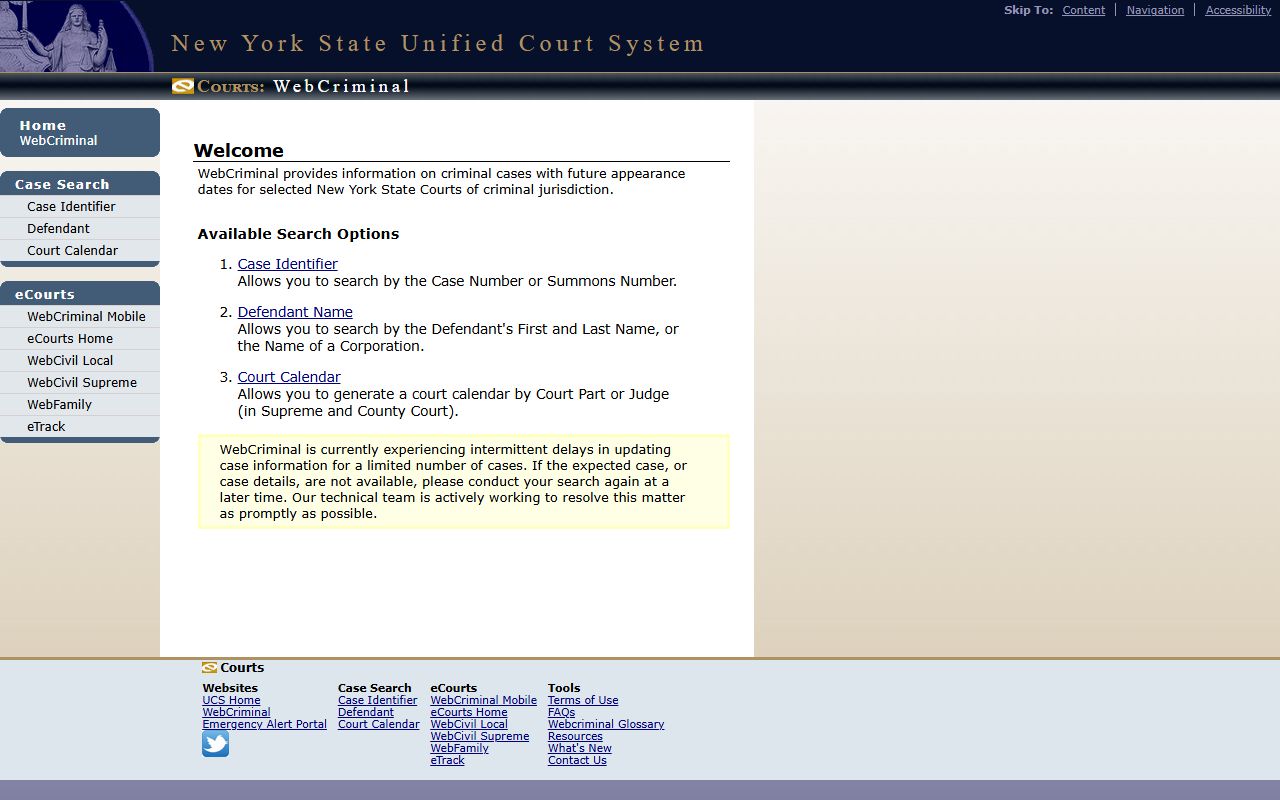
The portal shows appearance and case data where the law permits, but it is not a full criminal history and should not be treated as one.
Queens County Supreme Court vs the Lower Courts
Queens has several courts, and they do not overlap much. The Supreme Court takes the big cases. The lower city courts take the smaller ones. Knowing which court holds your matter saves a wasted trip and a failed search. The table lines up the three courts most people confuse.
| Court | Level | Main Case Types | Location |
|---|---|---|---|
| Supreme Court | General trial court | Major civil suits, divorce, indicted felonies | Civil: 88-11 Sutphin Blvd; Criminal: 125-01 Queens Blvd |
| Criminal Court | Lower city court | Arraignments, misdemeanors, violations, early felony steps | 125-01 Queens Blvd, Kew Gardens |
| Civil Court | Lower city court | Lower-dollar civil, small claims, housing | 89-17 Sutphin Blvd, Jamaica |
The Supreme Court sits above the lower courts in scope. A felony starts in Criminal Court, then moves to the Supreme Court Criminal Term after indictment. A small civil claim stays in Civil Court and never reaches the Supreme Court at all.
How a Queens Case Moves Through the System
A criminal case does not stay in one place. It climbs through the court structure as it moves toward a final outcome. The flow below traces a felony from the first appearance up to the highest court. Most cases end long before the top, often by plea or dismissal.
The path runs in a clear order:
- Criminal Court handles the arraignment and the early steps after arrest.
- Supreme Court Criminal Term takes the felony once a grand jury indicts.
- Appellate Division, Second Department hears the appeal from a Supreme Court ruling.
- Court of Appeals may take the case last, but only in limited situations.
Civil cases follow a similar climb. A Supreme Court civil judgment can be appealed to the Second Department, and from there a party may seek review at the Court of Appeals. Each step creates its own record in its own court, so an appeal record is searched in the appellate court, not just the trial docket.
Appeals From Queens Supreme Court
An appeal is a request for a higher court to review a lower court's ruling. It is not a new trial. The higher court reads the record and the briefs and decides whether the law was applied right. For Queens, the first stop on appeal is usually the Appellate Division, Second Department, which sits in Brooklyn.
The Court of Appeals is the final word in New York. It does not take every case. Many appeals end at the Second Department. A trial docket may show a notice of appeal, the settled transcript, and the record on appeal, but the full appellate file lives in the appellate court. Search both places when you track an appeal.
Note: A notice of appeal in the trial docket only starts the process, so check the Appellate Division record to learn how the appeal was actually decided.
Case Types in Queens Supreme Court Records
The Supreme Court covers a wide span of matters, which is why its records are so varied. Civil and criminal files share the same court name but follow different rules and use different identifiers. The list groups the most common record types a Queens searcher will meet.
- Civil litigation - tort, contract, and commercial suits with an index number.
- Foreclosure - mortgage actions with notices of pendency and judgments of sale.
- Matrimonial - divorce and related relief, with access limited under Domestic Relations Law 235.
- Article 78 - special proceedings that challenge a state or city agency action.
- Name change - adult name change petitions and final orders.
- Criminal - indicted felonies, pleas, sentences, and orders of protection.
Divorce sits in the Supreme Court but stays partly closed by law. For the marriage and divorce side, the Queens County divorce records page covers how those files are reached and what stays restricted.
Reading Queens Supreme Court Dockets
A docket is the running list of events in a case. It shows the index number, the case caption, the filing date, the assigned judge or part, and every motion, order, and judgment in date order. The docket is the spine of the file. Once you can read it, the rest of the case makes sense.
For civil cases, the docket connects the case data in the public search tool with the documents in the e-filing system. A title can appear in the docket even when the document is sealed or was filed only on paper. Personal data such as Social Security numbers and minor names is redacted. For a deeper walk through docket fields, see the Queens County court dockets page.
Criminal dockets read differently. They show charges, the statute sections, arraignment dates, bail or remand status, adjournments, pleas, and the disposition. Sealed criminal dockets do not show at all.
Specialty Courts in Queens
The Queens court system runs problem-solving courts alongside the regular calendars. These programs aim to address the cause of a case, not just punish it. The Queens Treatment Court screens eligible defendants for substance use disorders and requires treatment, testing, court reviews, and case management. Completion can improve a case outcome, though many violent or legally barred cases are not eligible.
Queens also uses mental-health diversion and supervised release for some defendants. Veterans resources exist in parts of the state court system, but the active Queens calendar should be confirmed with court staff. One point holds across all these programs: the clinical records that support treatment stay confidential. A problem-solving court is a supervised program, not a public database, so the medical and treatment files behind it are not open to search.
Supreme Court vs Federal Court
The Queens County Supreme Court is a state court. It is not the same as the federal court that also serves the borough. Queens sits in the Eastern District of New York. Federal civil and criminal cases that arise in Queens are filed there, with courthouses in Brooklyn and Central Islip. Federal appeals go to the Second Circuit, not the Appellate Division.
The two systems keep separate records and use separate numbering. A state index number means nothing in the federal system. Federal files are searched through PACER, the national case-access tool, while state files use the eCourts tools. Airport and customs matters from JFK and LaGuardia often land in federal court rather than the Supreme Court, so check both when a case could be either.
Queens Supreme Court Courthouse Location
The Civil Term and the County Clerk share the courthouse at 88-11 Sutphin Boulevard in Jamaica. This is the primary stop for civil files, judgments, name changes, and certified copies. The Criminal Term sits apart at 125-01 Queens Boulevard in Kew Gardens. Plan your trip around the term that holds your case, since the two buildings are not close to each other.
The Jamaica courthouse cluster is reached most easily by transit. The Sutphin Boulevard-Archer Avenue-JFK Airport subway station and the Jamaica LIRR station sit near the civil courthouse. Parking is urban and limited, so transit is often the better choice. Allow time for security screening at every court building, and bring photo ID and your case papers.
You can view the Queens Supreme Court Civil Term page for the official courthouse details.

The building holds the Civil Term and the County Clerk, so most civil record requests in Queens start at this Sutphin Boulevard address.
Public Record Search
Sponsored Results