
How to Search Queens County Court Records
Start by naming the court. Queens runs several separate court systems, and each one holds its own files. Supreme Court Civil Term covers large civil cases, divorce, judgments, and name changes. Supreme Court Criminal Term handles indicted felonies. Criminal Court takes arraignments, misdemeanors, and violations. Civil Court hears small claims and housing matters. Family Court keeps custody, support, and related cases, and most of those are not public. Surrogate's Court holds wills and estates. Once you know the court, you know the portal.
Have a few details ready before you search. An index number or docket number gets you the cleanest result. A full party name plus a filing year works when you do not have a case number. Common surnames bring back many hits, so a date range helps.
- Pick the court that matches your case type.
- Open the matching portal: WebCivil Supreme for Supreme Court civil cases, or NYSCEF for e-filed documents.
- Search by index or docket number first, then by party name and Queens County.
- Open the case to read the docket entries and party names.
- Ask the clerk for a certified copy if you need an official record.
The statewide eCourts tools are the main public entry point. To look up Queens County Court records for a civil suit, WebCivil Supreme is the place to start, as shown in the New York court system search screen below.
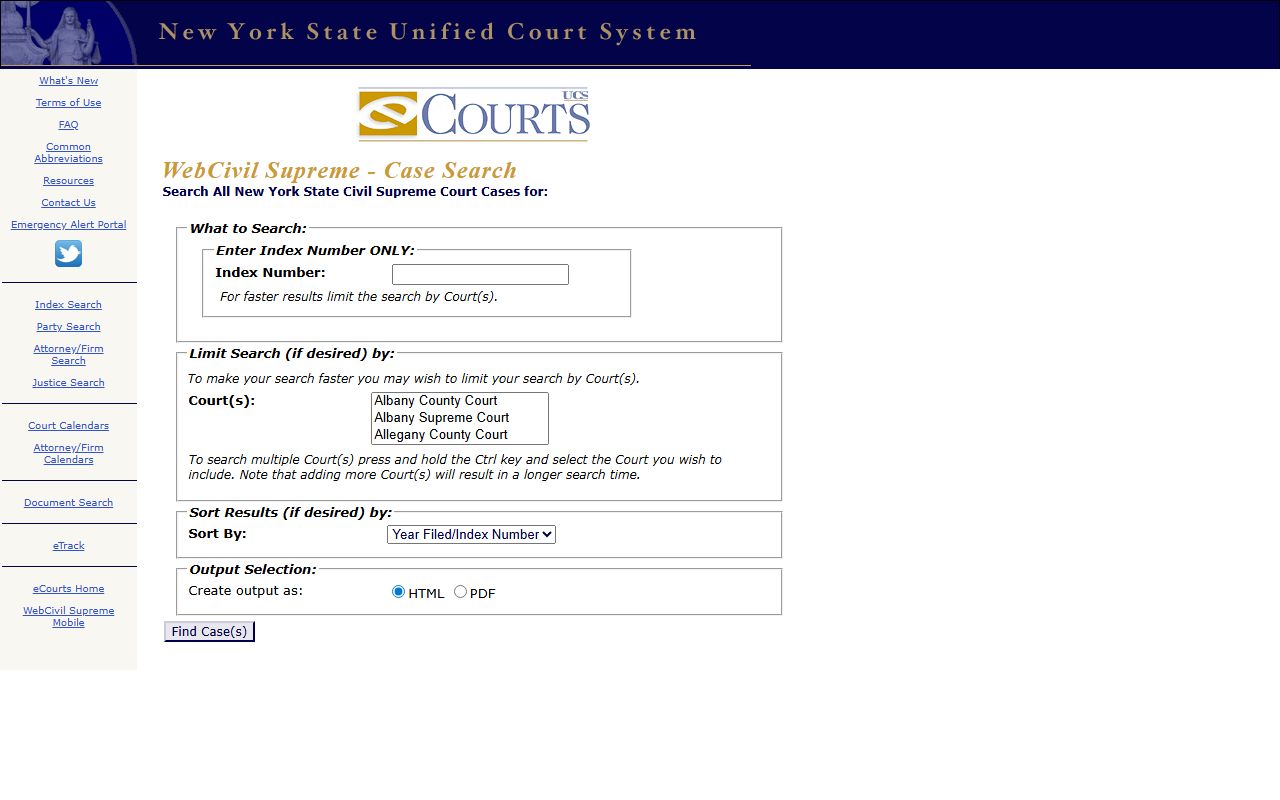
The form lets you set the county to Queens, type an index number, or enter a party name. A docket page tells you the parties, the filing date, the case type, and the assigned judge.
The Queens County Judicial System
New York names its courts in an odd way. The Supreme Court is the main trial court, not the top appeals court. The Court of Appeals in Albany is the highest court. In Queens, the Supreme Court runs a Civil Term and a Criminal Term. Below it sit the New York City courts: Criminal Court, Civil Court, Housing Court, and Family Court. Estates go to Surrogate's Court. Queens has no justice of the peace or village courts, because it is a New York City borough.
Appeals from Queens trial courts usually go to the Appellate Division, Second Department, then to the Court of Appeals. Federal cases that arise in Queens are filed in the U.S. District Court for the Eastern District of New York, a separate system.
Case flow: Criminal Court › Supreme Court Criminal Term › Appellate Division, Second Department › Court of Appeals
| Court | Role in Queens | Case Types |
|---|---|---|
| Supreme Court | General trial court | Civil suits, divorce, felonies, foreclosures |
| Criminal Court | NYC lower criminal court | Arraignments, misdemeanors, violations |
| Civil Court | NYC lower civil court | Small claims, lower-dollar civil, housing |
| Family Court | Family matters | Custody, support, neglect, family offense |
| Surrogate's Court | Estates | Wills, administration, guardianship |
For a deeper look at the main trial court, see the Queens County Supreme Court page.
Queens County Courthouses
Queens court buildings cluster in two areas. Civil and clerk matters center on Sutphin Boulevard in Jamaica. Criminal matters center on Queens Boulevard in Kew Gardens. Family Court sits on Jamaica Avenue. Knowing the building saves a wasted trip, since each one holds different files.
Queens Supreme Court, Civil Term
88-11 Sutphin Boulevard
Jamaica, NY 11435
Houses the Queens County Clerk and civil case files.
Queens Supreme Court, Criminal Term
125-01 Queens Boulevard
Kew Gardens, NY 11415
Indicted felonies and Criminal Court matters.
Queens Family Court
151-20 Jamaica Avenue
Jamaica, NY 11432
Custody, support, and family offense cases.
Queens Civil Court sits close by at 89-17 Sutphin Boulevard in Jamaica. Surrogate's Court has its own clerk and filing desk for estate work.
Types of Court Records Available in Queens County
Queens court records cover a wide range. The type of case decides where the record lives and how much of it is public. Supreme Court civil files and many County Clerk records are open to most searchers. Criminal, family, and matrimonial files carry more limits.
Different courts produce different records. A civil suit creates an index number and a docket. A criminal case creates a docket, charges, and a disposition. An estate creates a file number and letters.
- Civil records - lawsuits, judgments, foreclosures, and name changes from Supreme Court and Civil Court.
- Criminal records - charges, pleas, and dispositions from Criminal Court and Supreme Criminal Term.
- Family records - custody, support, and family offense cases, most of them confidential.
- Surrogate records - wills, administration, and guardianship through Surrogate's Court.
- Traffic records - tickets and driving charges split across city, DMV, and court systems.
What Queens County Court Records Show
A court record is built from fields. Once you can read those fields, a docket stops looking like code. Supreme Court civil cases use an index number. Criminal Court uses a docket number. Surrogate's Court uses a file number. The case caption names the parties, and the docket lists every filing and order in date order.
| Field | What It Shows |
|---|---|
| Case / Index Number | The court's unique ID for the case. |
| Filing Date | When the case was started. |
| Parties | Plaintiff and defendant, or petitioner and respondent. |
| Charges / Cause | The crime charged or the civil claim raised. |
| Disposition | How the charge, motion, or case ended. |
| Judgment / Sentence | The relief awarded or the punishment imposed. |
For e-filed civil cases, the actual documents live in NYSCEF, New York's electronic filing system shown below.
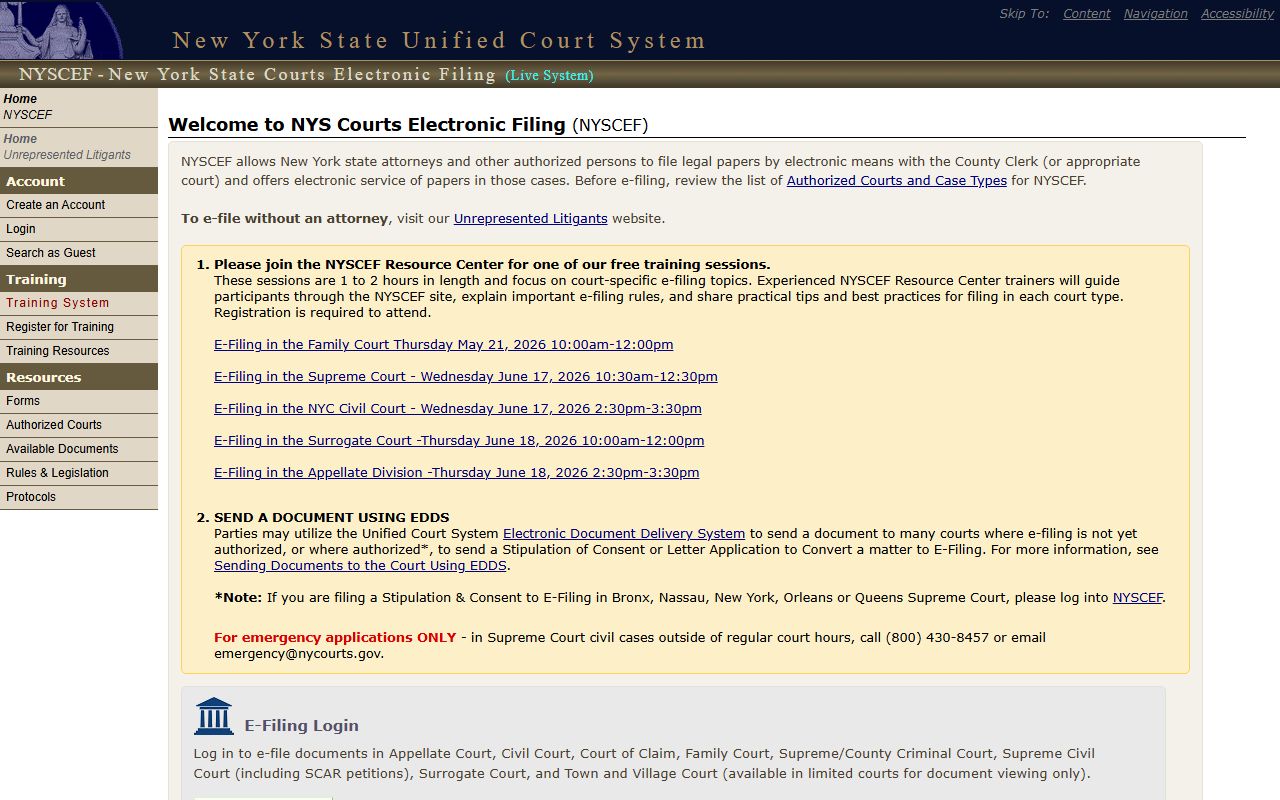
You can reach NYSCEF as a guest, search by index number, and download public PDFs. Sealed or restricted documents will not open, even when the title shows. More detail sits on the Queens County court records page.
Public Access Laws for Queens County Court Records
New York treats court records and agency records differently. Court files follow Judiciary Law, court rules, and sealing statutes. Agency files, like jail logs or police reports, follow the Freedom of Information Law. The state recognizes a strong right to see court records, but that right yields to specific statutes and sealing orders.
A few key laws shape what you can see in Queens. They are worth knowing before you assume a record is open.
Key Statutes:
New York Public Officers Law § 84 - states that open government and public access are central public policy.
New York Judiciary Law § 255 - requires court clerks to search files and certify records they hold.
New York Criminal Procedure Law § 160.50 - seals records after a criminal case ends in the person's favor.
See the Queens County public records page for how to file a Freedom of Information request with a city or state agency.
Records That Are Restricted or Confidential
Not every file is open. Some are sealed by law, and no search site can give you a sealed record. Dismissed criminal cases seal automatically under CPL 160.50. Youthful offender cases stay confidential. Family Court files are restricted under Family Court Act 166. Divorce papers are limited by Domestic Relations Law 235. Adoption files are sealed.
To view a restricted record, you usually need to be a party, a lawyer, or an agency named in the law. For sealed civil files, a person can ask the court to unseal by showing good cause. The clerk may require a motion or a court order. If a search returns nothing, the case may exist but be hidden by law.
Specialty Courts in Queens County
Queens uses problem-solving courts for some criminal cases. These programs aim to treat the cause of repeat offending rather than just punish it. The Queens Treatment Court screens defendants for substance use and requires treatment, testing, and regular court reviews. Finishing the program can lower the sentence or improve the case outcome, subject to prosecutor and judge approval.
Mental health diversion and supervised release give other paths for eligible defendants. Veterans treatment resources exist in parts of the New York court system, though the active Queens calendar should be confirmed with court staff. Clinical records from these programs stay confidential and never show up in a public docket.
Queens County Jail and Inmate Information
Queens has no county sheriff jail roster. People arrested in Queens and held in custody are in the care of the New York City Department of Correction, often at Rikers Island. The NYC Sheriff is a civil enforcement office under city finance, not a jail operator. So the inmate search for Queens runs through NYC DOC, not a county site.
A Queens arrest moves from the police precinct to central booking, then to a Criminal Court arraignment. If the judge sets bail that is not posted, or orders the person held, DOC becomes the custodian. Full roster details sit on the Queens County inmate records page, and active warrants are covered on the warrant records page.
Marriage, Divorce, and Surrogate's Court Records
Marriage in Queens runs through the New York City Clerk, not the county. Divorce is a Supreme Court matter, but the papers are limited from public view. Estates go to Surrogate's Court, which New York uses instead of the term probate court. See the marriage and divorce records page and the Surrogate's Court page for the full process.
- Testator
- A person who makes a will.
- Executor
- The person named in a will to settle the estate.
- Administrator
- The person the court names to settle an estate with no will.
- Distributee
- An heir who inherits when there is no will.
Queens County Court Records Fees
Searching online is usually free. Copies are not. The clerk charges set fees for searches, certified copies, and exemplified copies, and those amounts are fixed by statute and court schedule. A certified copy carries the clerk's seal and is the version courts and agencies accept. A free screenshot is not certified proof.
| Item | How the Fee Is Set |
|---|---|
| Online case search | Generally free through eCourts and NYSCEF guest access. |
| Certified copy | Set by clerk fee schedule and statute; confirm with the clerk. |
| Records search by clerk | Statutory search fee charged by the holding court. |
| Federal PACER documents | Per-page federal access fee, subject to fee caps and waivers. |
Confirm the current amount with the Queens County Clerk before you mail a request, since fees change.
How to Interpret Queens County Court Records
Court records use shorthand. A docket entry of "RJI" means a Request for Judicial Intervention, the step that asks the court to assign a judge. "Disposed" means the case ended, not always how. A charge is only an accusation. A conviction is a finding or plea of guilt. The two are not the same, and a record that shows a charge does not show guilt.
Criminal cases list a docket number, charges, and a disposition. Civil cases list an index number, the cause of action, and any judgment. When a code is unclear, the clerk for that court can explain it. Do not treat an online status as final for a legal deadline.
Accuracy and Record Limitations
Online court data can lag. A filing made today may not post for a day or more. Sealed updates may never show. A name search can miss a case filed under a different spelling, and a common name can return the wrong person. Always match the index or docket number, the parties, and the filing year before you rely on a result.
Note: Confirm any case detail with the clerk for that court before you act on it, since online records can lag, omit sealed updates, or list a similar name.
History of Queens County Courts
Queens became one of New York's original counties in the colonial era, then joined New York City as a borough in 1898. That dual identity still shapes records today. Queens is a county for state court venue and a borough for city services. So a search can pull up state court pages, city agency pages, and county labels at the same time.
Jamaica grew into the civil court and clerk hub because of its rail and subway access, while Kew Gardens became the criminal court center. Over the years, New York moved many filings online through NYSCEF and opened public case data through eCourts, WebCivil, and WebCrims. Those systems are the modern front door to Queens court records.
Frequently Asked Questions
Is Queens County Court the same as Queens Supreme Court?
In New York City, the main trial court is the Supreme Court. County Court exists outside the city, but in Queens the felony and major civil matters run through the Supreme Court and the New York City courts. So when people say Queens County Court, they often mean the Supreme Court or one of the lower city courts.
Where do I get a marriage license in Queens?
Use the New York City Clerk, not the Queens County Clerk. The City Clerk runs the marriage license process for all five boroughs through an appointment workflow. The county clerk does not issue marriage licenses, so a trip there for one would waste your time.
Does Queens have a sheriff jail roster?
No county-run roster exists. Queens detainees are held by the New York City Department of Correction, mostly at Rikers Island. The official lookup is the NYC DOC inmate search, covered on the inmate records page.
More answers sit on the Queens County court records FAQ page.
Public Record Search
Sponsored Results