
What Queens County Criminal Court Handles
The Criminal Court is the lower city court for criminal matters in Queens. It is the first stop for most cases. The court handles arraignments, misdemeanors, violations, and the early steps of felony cases before they move up. It sits in the Kew Gardens court complex at 125-01 Queens Boulevard, the same complex that houses the Supreme Court Criminal Term.
Misdemeanors and violations often run their full course in Criminal Court. A misdemeanor is a lesser crime, and a violation is below that. These cases may end with a plea, a dismissal, or a small sentence without ever reaching the Supreme Court. The Criminal Court is where the bulk of day-to-day criminal work in Queens takes place.
Felonies are different. Criminal Court handles the first appearance and preliminary steps, then the case moves to the Supreme Court Criminal Term once a grand jury votes an indictment.
Criminal Court vs Supreme Criminal Term
Two courts share the criminal work in Queens, and they split it by the seriousness of the charge. Criminal Court takes the early and lesser matters. The Supreme Court Criminal Term takes the indicted felonies. Knowing the split tells you which clerk to ask and which docket to search.
| Court | Handles | Identifier | Location |
|---|---|---|---|
| Criminal Court | Arraignments, misdemeanors, violations, early felony steps | Docket number | 125-01 Queens Blvd, Kew Gardens |
| Supreme Criminal Term | Indicted felonies and serious criminal matters | Indictment number | 125-01 Queens Blvd, Kew Gardens |
A felony begins in Criminal Court but does not stay there. After indictment, the case shifts to the Supreme Court Criminal Term. For the trial court that takes those felonies, see the Queens County Supreme Court page.
Searching Queens Criminal Court Records
The main public tool for criminal appearance data is WebCrims. It shows case and appearance information for criminal matters where public access is allowed. WebCrims is not a background check. It is court and appearance data, and it leaves out sealed cases, youthful offender matters, and protected information. Treat it as a way to track a pending case, not as a full criminal history.
Search works best with a docket or indictment number. A defendant name plus the borough also works when you have no number. Court dates and parts can change quickly, so confirm any date with the court or counsel before you travel.
The fields below cover the main WebCrims inputs for a Queens search.
| Field | What to Enter |
|---|---|
| Defendant Name | Last name first; use exact legal spelling. |
| Case or Docket Number | Best exact lookup when known. |
| County / Borough | Select Queens. |
| Appearance Date | Narrows results to a court date range. |
You can open WebCrims to run a public criminal case search by Queens County and docket number.
Note: An empty WebCrims result can mean a case is sealed or restricted by law, not that the case never existed in Queens Criminal Court.
From Arrest to Arraignment in Queens
A criminal case record starts with an arrest, usually by the NYPD. After the arrest, the person is processed, fingerprinted, photographed, and checked for warrants. Then comes central booking and the trip to Queens Criminal Court for arraignment. The arraignment is the first court appearance, and it sets the tone for the case.
The step-by-step path looks like this:
- Arrest by the NYPD or another agency in Queens.
- Precinct processing, fingerprints, photos, and a warrant check.
- Central booking and transfer toward the courthouse.
- Arraignment in Queens Criminal Court, where charges and release are addressed.
- Release on recognizance, supervised release, bail, or remand by the judge.
At arraignment the judge reviews the charges, hears the prosecutor and defense, and decides release conditions. If bail is set and not posted, or if the judge orders remand, the person enters city custody. For where to find a person held after arrest, see the Queens County inmate records page.
Key Queens Criminal Court Terms
Criminal records use words that carry exact meaning. A few terms come up again and again in a Queens criminal file. Knowing them helps you read a docket without guessing.
- Arraignment
- The first court appearance, where charges are read and release conditions are set.
- Indictment
- A grand jury accusation that moves a felony up to the Supreme Court Criminal Term.
- Plea
- The defendant's formal answer to a charge, such as guilty or not guilty.
- Disposition
- The outcome of a charge or case, such as a conviction, dismissal, or acquittal.
- Remand
- An order that holds a defendant in custody without the option to post bail.
These terms show up across the docket events. A disposition is the field most people want, since it tells you how the case actually ended.
The Queens DA and Public Defense
The Queens County District Attorney prosecutes crimes that arise in the borough. The office is led by District Attorney Melinda Katz. It handles felonies, misdemeanors, and violations and runs bureaus for major crimes, domestic violence, special victims, appeals, and conviction integrity. Victims and witnesses can use the DA site for contact details, case resources, and victim services.
On the other side stands public defense. A person who cannot afford a lawyer can ask for assigned counsel at arraignment. Queens Defenders and The Legal Aid Society are the main institutional providers in the borough. Their work covers far more than trial. It includes arraignment advocacy, bail arguments, investigation, plea talks, sentencing, and screening for immigration consequences.
You can reach the Queens County District Attorney for prosecution and victim resources, or Queens Defenders and The Legal Aid Society for defense help.
Sealing Queens Criminal Records
New York leans on sealing more than expungement. When a criminal case ends in the defendant's favor, the record seals automatically under Criminal Procedure Law 160.50. Arrest, prosecution, and court records are then closed from public view, with limited exceptions for law enforcement and certain agencies. A favorable end usually means a dismissal or an acquittal.
Some older convictions can be sealed by application under CPL 160.59, but only if the person meets waiting-period, conviction-count, and offense-type limits. That sealing is not automatic. New York also has separate marijuana relief tied to legalization, which is narrower than a general expungement. For a deeper look at arrests and how charges differ from convictions, see the Queens County arrest records page.
Certificates of Disposition
A certificate of disposition is an official statement of how a criminal case ended. People need one for jobs, licensing, immigration, and other formal uses. A free screenshot of a docket is not the same thing. The certificate comes from the criminal court clerk for the case, and it carries the court's seal.
To request one, give the clerk the defendant name, the date of birth if asked, the docket or indictment number, and identification. Sealed cases limit what the clerk can release. If the case is sealed, the person it concerns may still be able to get a record of the sealing, but a third party usually cannot. A certificate is the document to ask for when an agency wants proof of the outcome.
After a State Prison Sentence
City jail and state prison are not the same system. A person held before trial or on a short city sentence is in New York City custody. A person who gets a longer felony sentence moves to state prison, run by the Department of Corrections and Community Supervision. The custody search changes once that transfer happens.
If a Queens defendant is sentenced to state prison, the right lookup is the DOCCS incarcerated individual search, not the city jail tool.
New York DOCCS runs the state prison system and its custody lookup.
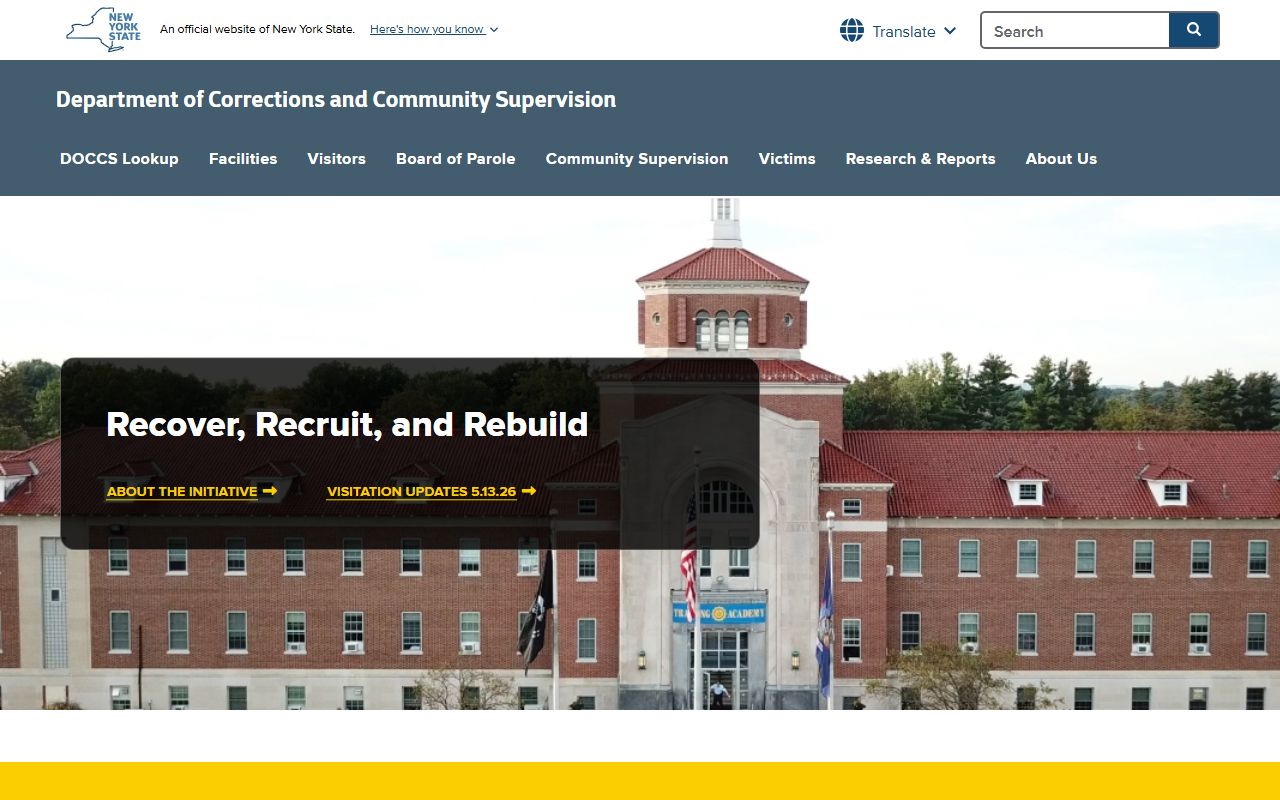
The DOCCS lookup searches by name or department number and confirms state custody for sentenced cases that began in Queens.
Public Record Search
Sponsored Results