
What Queens County Family Court Handles
The Family Court deals with the legal side of family life. It sits at 151-20 Jamaica Avenue in Jamaica, apart from the other Queens courts. The cases it hears touch children, parents, and household safety. They are some of the most sensitive matters in the whole court system, which is why the records get strong protection.
The court covers a defined set of case types. The list below shows the main ones a Queens family file may involve.
- Custody and visitation - who a child lives with and the schedule for time with each parent.
- Child and spousal support - orders for ongoing payments and enforcement.
- Paternity - legal findings of parentage.
- Neglect and abuse - child protective cases brought to keep children safe.
- Juvenile delinquency and PINS - cases involving young people and persons in need of supervision.
- Family offense - petitions for protection from a family or household member.
Each case type creates its own kind of record, and each carries privacy rules tied to the people it affects.
Confidentiality Under Family Court Act 166
Family Court records are not open the way most civil files are. The records of the court are restricted under Family Court Act 166. The law limits who may inspect a Family Court file. The goal is to protect children, survivors of violence, and family privacy. A stranger cannot walk in and read a custody or neglect file the way they might read an ordinary lawsuit.
This is the core rule that shapes every Family Court search. Public lookup tools show little, because the law keeps the files closed. Access usually flows to the parties, their attorneys, and agencies named in the statute. Even then, a judge can set further limits on sensitive parts of a file.
You can read the text of Family Court Act 166 for the rule on inspection of Family Court records.
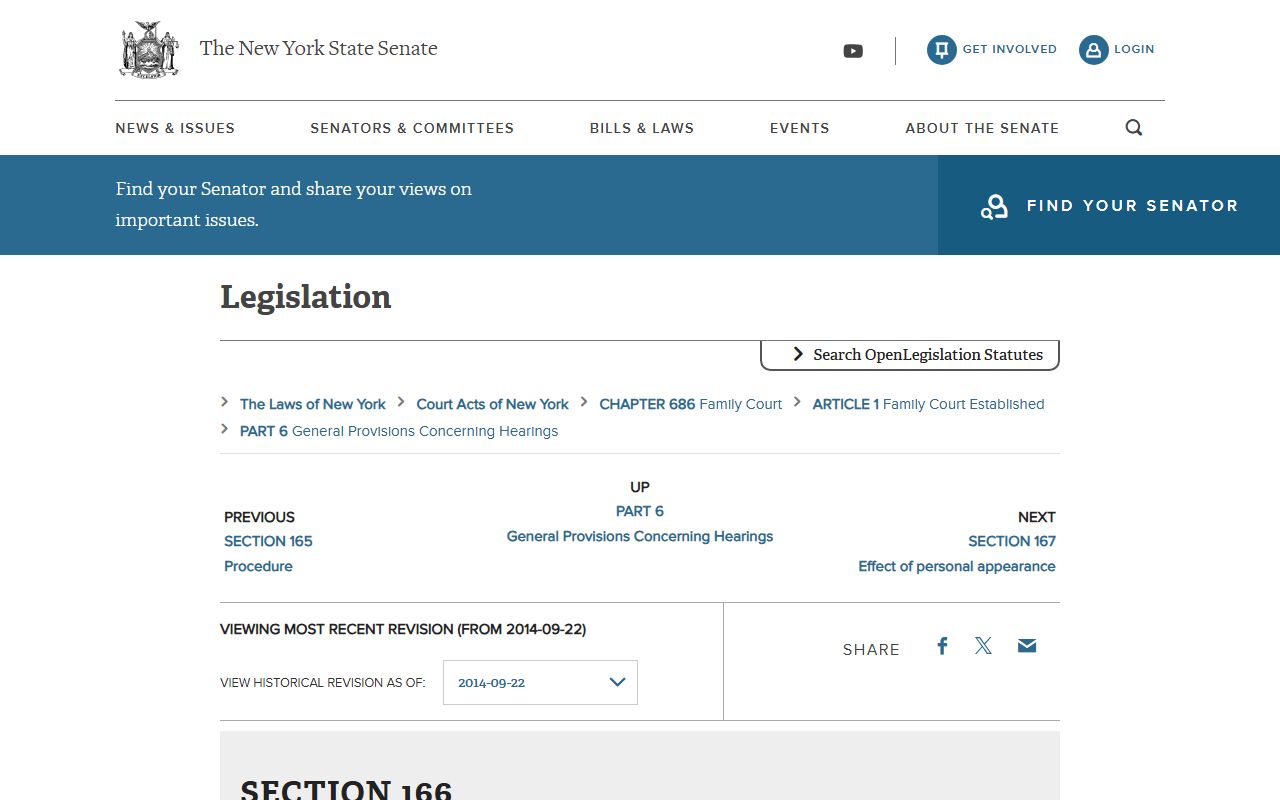
The statute is the reason Queens Family Court files stay closed to the general public, with access reserved for parties, counsel, and authorized agencies.
Note: A blank public result for a Queens family case usually reflects confidentiality under Family Court Act 166, not the absence of any case in the court.
WebFamily and Its Limits
New York runs a tool called WebFamily for Family Court case information. Its reach is narrow on purpose. Because so many family matters are confidential, the public side of WebFamily shows only limited data. It is not a place to dig into custody, support, or neglect details. Name-only searching is often not available or not appropriate.
A docket number is the key input where access is allowed. Parties and their lawyers may receive notices and access channels that the general public does not get. For the broad rules on what stays open and what stays closed across the Queens courts, see the Queens County public records page.
Family Court vs Supreme Court for Divorce
This is the point that trips up the most people. Family Court cannot grant a divorce. Only the Supreme Court can dissolve a marriage in New York. Family Court can decide custody, visitation, support, paternity, and family offense matters. But it cannot end the marriage itself. A person who only needs custody or support may use Family Court. A person who wants a divorce must go to the Supreme Court.
| Issue | Family Court | Supreme Court |
|---|---|---|
| Grant a divorce | No | Yes |
| Custody and visitation | Yes | Yes, within a divorce |
| Child and spousal support | Yes | Yes, within a divorce |
| Paternity | Yes | Limited |
| Equitable distribution of property | No | Yes |
So the same family can have a custody case in Family Court and a divorce case in the Supreme Court at the same time. For the divorce side and how those records are reached, see the Queens County marriage and divorce records page.
Key Queens Family Court Terms
Family cases use a set vocabulary, and a few terms appear in nearly every file. Knowing them helps a party read their own docket and understand the steps in a case.
- Petitioner
- The person who starts a Family Court case by filing a petition.
- Respondent
- The person who must answer the petition.
- PINS
- A person in need of supervision, usually a young person whose behavior brings a case.
- Family offense
- A petition seeking protection from a family or household member.
- Order of protection
- A court order that sets stay-away or no-contact conditions to keep a person safe.
These terms set the frame for a file. A family offense petition, for example, is the path that often leads to an order of protection.
Who Can Access Family Court Records
Access to a Queens family file depends on who you are. The parties to the case can usually see their own record. Their attorneys can too. Certain agencies named in the law, such as child protective and support agencies, may have access tied to their role. The general public is mostly shut out, and that is by design.
Even an authorized person may face limits on the most sensitive parts of a file. Addresses of protected people, details about children, and medical information can be blocked or redacted. Adoption files and many guardianship matters are sealed beyond the general Family Court rule. A judge can also order extra protection where safety is a concern. The default is privacy, and access is the exception.
How a Party Views Their Own Case
A party to a Family Court case has the strongest path to the record. If you are the petitioner or the respondent, you can usually view your own docket and get copies of your own orders. The route is the Family Court clerk, not a public website. You will likely need to show identification and prove your status in the case.
The basic steps run like this:
- Confirm your role in the case as petitioner, respondent, or counsel.
- Gather the docket number, the party names, and the year of filing.
- Contact or visit the Queens Family Court clerk on Jamaica Avenue.
- Show photo identification and prove you are a party or authorized person.
- Ask for the specific document or order you need, plain or certified.
You can review the Family Court FAQs for common questions about access and procedure. The clerk can confirm what you may view based on your role.
Legal Aid for Queens Family Matters
Family cases are hard to handle alone, and help exists. Several organizations serve Queens residents with custody, support, family offense, and related matters. Free and low-cost legal services can guide a parent through filing, hearings, and orders. Getting advice early can change the path of a case.
The Legal Aid Society and Legal Services NYC both handle family work across the borough. For people facing domestic violence, advocacy groups offer safety planning along with legal help. A general directory can point you to the right office when your issue does not fit one group.
You can start with The Legal Aid Society for family and civil help, or the LawHelpNY directory to find a service that fits your situation.
Public Record Search
Sponsored Results